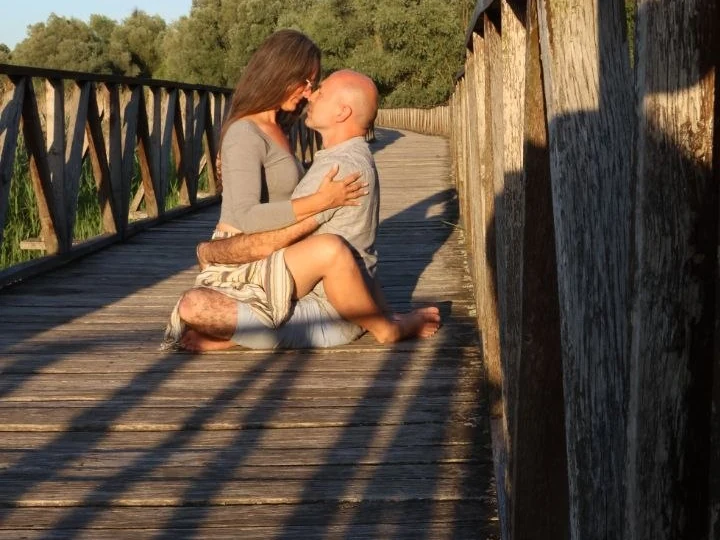
When Siniša and I agree that we will have a date in the evening, go for a drink, take a walk or simply go somewhere together, just the two of us, something in me starts to change during the day. It is as though I am preparing for that meeting, not only by choosing what to wear but also inside, and playfulness and imagination slowly begin to wake up in me. I feel my Eros becoming more alive and joyful, as though it has realised that we have finally made room for it.
I find this interesting every time: Eros did not wake up only in the evening, through touch. It started waking up much earlier, with our decision to meet as lovers.
But what happens when, during the day, we do not meet our partner as a lover, but as a child we have to take care of? Or as a parent, therapist or authority figure onto whom we shift our own responsibility?
We all sometimes find ourselves unable to manage alone. Life overwhelms us, we are tired, vulnerable or afraid, something happens to us, and of course we lean on the person closest to us. A relationship needs to be able to hold those moments. Sometimes we offer each other something maternal or paternal, sometimes we listen to our partner as a therapist might, help them settle and stay beside them through an emotional storm. I do not want a relationship in which nobody leans on anyone and everyone proudly insists that they need no one. To me, that is not adulthood; often it is another form of defence.
The problem does not arise when we sometimes lean on each other. It arises when that support allows one partner to unconsciously decide not to develop, not to take responsibility for some part of life and not to grow up, because the other will do it for them anyway.
Support, or a decision not to grow up?
He has never learnt how to do the laundry or turn on the washing machine. She has always washed, dried and folded it. Years pass, and in that part of life he remains a boy who cannot even take care of his own laundry. Not because he cannot learn, but because he has never had to. She takes care of it, then becomes more and more tired and angry, but continues doing the same thing.
Or the other way round. She has never liked dealing with finances. It is easier for her to let him study loans, taxes, investments, interest rates and financial statements, make decisions about their shared money, and then take responsibility if a decision turns out to be wrong. In that part of life she remains a girl who has never fully stepped into her own financial adulthood. Not because a woman must manage all the family finances herself, but because she has decided to know nothing about something that directly shapes her life.
Sometimes that division is completely fine. If one person loves cooking and the other genuinely cannot stand the kitchen, there is no reason to divide the cooking exactly in half just to make their relationship look equal from the outside. They can consciously decide that one will cook, the other will wash the dishes or take on something else entirely. The problem is not who turns on the washing machine, cooks or changes the winter tyres.
The question is whether we made that decision consciously and whether it still suits us, or whether we have ended up in a division of roles in which one person feels used, the other becomes increasingly helpless, and both pretend not to know why they are angry.
Then we no longer have only different tasks. We have a parent and a child.
A similar dynamic can develop in our emotional lives. One person has never learnt to stay with themselves when an emotional storm arrives. Whenever they are overwhelmed, they expect their partner to know what to say, how to calm them, how to interpret what is happening to them, how to remove their discomfort and restore their sense of safety. Of course our partner sometimes needs to hold space for us. But if, every day, they are the only pillar that must withstand every one of our storms, they are no longer only our partner. They have become the regulator of our emotional world, our therapist and our parent.
And in that part of ourselves, perhaps we have remained small.
These roles are not tied to gender. A man can become the child whom a woman guides through practical life, while a woman can become the girl who expects a man to make decisions and keep everything under control. Equally, a woman may carry the entire emotional and practical world of the relationship while a man withdraws, and a man may take care of a partner who does not take responsibility for herself. The roles change; sometimes we even move between them within a single day. The point is not to prove who is to blame. It is to see where an adult stopped growing because the other person began carrying them.
The price our relationship as lovers pays
Sooner or later, the body feels what we may have been unwilling to say for years.
Tiredness and irritation appear. Touch that used to be an invitation becomes another demand. Playfulness disappears. Respect slowly fades, and with it our admiration for the person beside us. We feel as though we are always on duty: as mother, father, provider, cleaner, organiser, comforter, the one who solves every problem and knows whether the car has summer or winter tyres.
And then we wonder where desire has gone.
It is hard to feel passion for someone you were taking care of as a child only a few hours earlier.
If a man constantly asks a woman to be his mother during the day, she may find it difficult to see him as an adult lover in the evening. If a woman constantly expects her husband to regulate her emotions and be the authority who knows, decides and rescues, he may become tired of the parental role and lose contact with her as an adult erotic partner. These are not rules about men and women. The roles can be reversed. I am talking about the price a relationship may pay when adulthood is lost between two adults.
Desire is not a switch, and we cannot explain its disappearance through a single dynamic. Tiredness, chronic stress, health, hormones, medication, trauma, unspoken anger, pressure, routine, and a lack of touch, space and novelty all affect it. I am not claiming that every absence of desire means one partner has become the other's parent, or that desire will automatically return as soon as we learn to do our own laundry.
But it is worth asking: do I still meet the person beside me as a lover? Or have I spent so long seeing them as someone I must carry that my body no longer knows how to move from care into desire?
And from the other side: which part of my own life am I still refusing to take responsibility for because it is easier to let my partner carry it for me?
Returning to the lover within us
For me, returning does not begin with a demand that Siniša change and awaken the lover in me. First, I return to her myself.
I nurture myself. I care for my body. I treat myself as a lover, not only as a woman who works, organises, takes care of others and finishes whatever needs to be finished. I do not wait for someone outside me to remind me that I am alive, sensual and playful. I am learning again to build a relationship with that part of myself, and then I bring her into our partnership.
The same is true for the male lover. A man does not become a lover simply by asking his partner for more sex. A lover nurtures his presence, his body, his aliveness and his ability to meet another person without asking her to complete him, raise him or constantly confirm his worth.
Our relationship as lovers needs a place in our real lives. It needs time. Sometimes it also needs money that we consciously set aside for an evening out, a trip, childcare or an experience that is not just another obligation. It needs our attention and our decision, for at least a few hours, not to be organisers, parents, colleagues and problem-solvers.
That is why even an evening out we have already agreed on changes me during the day. Anticipation sets my imagination in motion. I begin preparing for our meeting. My Eros senses that it will have space, becomes more alive and seems already to be looking forward to what is coming. Not because every date must end in sex. It does not have to. There is already value in our decision to come to each other again as lovers.
Adulthood does not happen by itself
When a couple recognises that they are stuck in a parent-child relationship, the first step is not to coldly declare: ‘From today, manage on your own.’ Adulthood does not mean removing tenderness, support or the ability to lean on each other. It asks each person to look at what they persistently avoid developing in themselves and what they expect their partner to do for them.
The person who leans too heavily on the other needs to take responsibility for that part of life. The other person needs to stop automatically rescuing, fixing and carrying, even when that role has become part of their identity and proof of their own worth. Together, the couple needs to look again at the divisions they may once have made unconsciously: which still suit them, and which have become sources of anger and contempt.
And sometimes it is fine to seek a therapist, a third person who is not emotionally involved in our lives and can offer a perspective we cannot currently see ourselves. A therapist is not a substitute mother or father, but a professional who can help us become aware of our patterns, develop capacities we lack and take responsibility for what we bring into the relationship today.
In couples therapy, we look at what we create together. We do not look for someone to blame, but recognise how one person becomes smaller and the other bigger, how rescuing produces more helplessness, and helplessness produces more rescuing. Here, a couple can learn to return responsibility to each person without removing closeness.
His part belongs to him. Her part belongs to her. And the pattern they create between them belongs to the relationship.
Three questions to take with you
In which role do I most often meet my partner: as a lover, child, parent, therapist or authority figure?
Which part of my own adult responsibility am I still shifting onto him or her?
What will I do this week, concretely, to nourish the lover within me?
Perhaps the answer is simple: arrange an evening walk, wear something that makes us feel alive, look at our partner without talking about bills and obligations. Perhaps we need to begin a conversation we have been putting off for a long time. Perhaps we need individual or couples therapy to see a pattern we can no longer recognise ourselves.
And sometimes we need more than one hour between two full days. We need enough time for the body to stop rushing, for our everyday roles to quieten a little and for us to remember what it feels like to be lovers.
At the GUŠTAM(O) retreat, a couple does not try to pretend to be who they once were or produce desire at any cost. We create space for you to step out of your everyday functions, connect as lovers and spend several days exploring the lover archetype through presence, the body, meeting each other, play and shared experience.
Couples therapy helps us see where we have lost ourselves in our roles and return responsibility to ourselves. A retreat gives us time to begin living differently what we have come to understand.
GUŠTAM(O) takes place in Rogoznica from 5 to 10 September 2026 and is intended for a small group of couples who want to consciously make room for their relationship and Eros.
You can find programme and registration details on the GUŠTAM(O) page, and if you feel that you first need a therapeutic space, you can also contact me for couples therapy.
The September 2026 dates mentioned in this article have passed. Please contact me about future dates.
GUŠTAM(O) couples retreat · Rogoznica · 5–10 September 2026
GUŠTAM(O) programme details