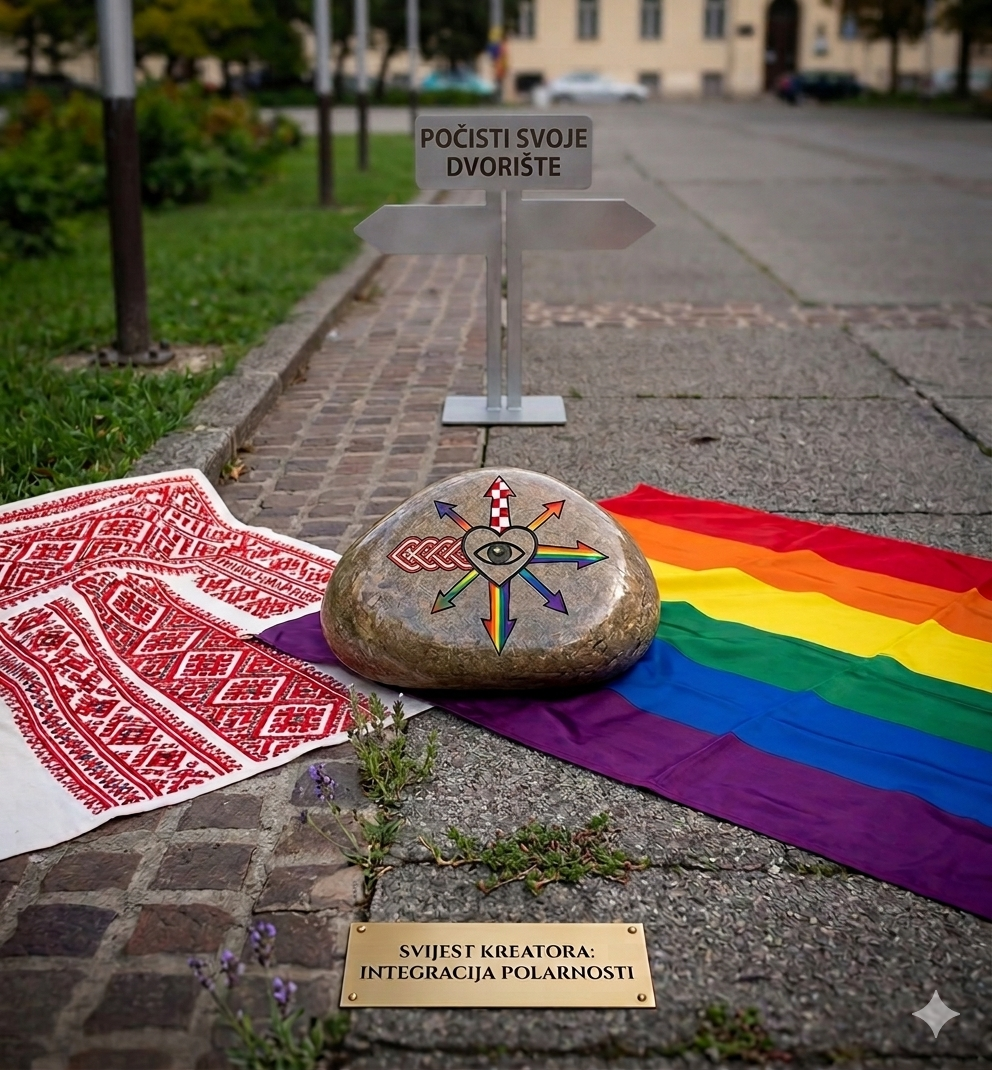
I have recently felt an urge to speak and show my perspective in a society that is deeply polarized. I want to come forward with my perspective because I want to act and invite a development of consciousness.
When the violent removal of the rainbow-colored flag happened yesterday in Croatia, followed by mass support from many people for that act, most analyses stopped at the surface: debates about laws, provocations, tradition, or rights.
I personally see that level only as a symptom, not as a cause. On that level, we cannot find a solution. Beneath the surface conflict lies a deep, pathological dynamic of a collective psyche trapped in cycles of trauma that refuse to heal and grow up.
If we want to understand why, as a society, we keep bleeding in the same places, we must look deeply into the mechanisms that move those wounds. We must understand the psychodynamics of conflict.
Yesterday, there was a collision of worlds that we can heal only if we rise above cheering and taking sides, and the integral model of Ken Wilber can support us in that. What happened in the streets and in the comments was not a conflict between “good” and “bad” people, but a frontal collision of two different perspectives that speak completely different languages and therefore fail to understand each other:
1. Ethnocentric (traditional) level of consciousness:
A large part of the traditional population in Croatia operates from this level of consciousness. For them, the key values are: a deep sense of belonging to the community, clear inner order, firm beliefs, tradition, and clearly defined roles. At this level, inner safety and peace depend on the environment reflecting the values and rules of that community.
When this group supports the removal of the rainbow-colored flag, in their own mind they are not doing evil. They are defending a “sacred thing” and inner order from what they perceive as chaos and a threat to survival. Every deviation from the rules feels to them like existential horror.
2. Worldcentric / Pluralistic level of consciousness:
This level of consciousness, at its core, celebrates individuality, diversity, human rights, and the dismantling of rigid, imposed structures. Its original message is: “There is not only one absolute truth; different cultures have their own legitimate views of the world.” At this level, inner safety and peace depend on a person’s capacity to be flexible enough to recognize what each situation requires and to act from a place of deep presence and wholeness.
This is the level of consciousness with which those who carry rainbow flags gladly identify, but in reality it is not always so. As a psychotherapist, I must emphasize that not all people who label themselves as being at this level are truly there.
Within the rainbow group, there are many who are at that level of consciousness while there is peace and things are good, but the moment conflict begins, they very quickly find themselves at the ethnocentric level, where projections start and the terms “us and them” appear again in their vocabulary.
Also, members of this group are often still searching for themselves, so they attract attention through their “rebellion,” while in reality they still do not know who they are. They are in a natural process of maturation and are walking through their own growing up.
Of course, there is a certain number of people who have truly embodied the pluralistic level of consciousness: those who, with full responsibility and maturity, live and advocate freedom for everyone. But that number is extremely small.
The tragedy of our society is that these two worlds do not know how to communicate and do not have awareness of when they fall back into the trap of “us and them.” As long as there is judgment and resentment, it is a sign that we have taken a step backward.
A pluralistic mind that condemns the traditional one as primitive and backward is no longer pluralistic. Meanwhile, the traditional mind sees the pluralistic only through its immature extremes, experiencing it as moral decay and a direct attack on the family as the core of society.
The result is total communication noise: a war in which they dehumanize each other, and both groups, in that moment, fall into an ethnocentric level of consciousness.
One side kneels “FOR life,” and the other walks “AGAINST,” and they actually fail to hear each other because they are too preoccupied with their own wound.
Public space and symbols:
In a conversation with my husband about this topic, I was shocked at first, because on one hand I know he supports many people from the LGBT community, but he said with such ease: “Why does that flag even have to be displayed on the main square or at the station? It is not right for any ideological flags to be displayed in a shared space, because if one group can do it, then by the same logic all others could do it too.”
And he is right.
As I listened to him, I became aware of what personally bothers me in that context.
It bothered me that displaying certain ideologies once again creates conflict, because there is no love and acceptance of the other side in it, but competition with the message “we are better.”
But what bothered me most was that, in that moment, I could also recognize my own taking of a side.
I became aware of how easy it is to slide into the space of us and them if we are not truly deeply connected with our body and our heart.
For our neurological system to feel safe and welcome in society, public spaces and institutions should be neutral zones, purified of the need to mark territory.
I understand that I live in a majority Christian country in which 70 to 80 percent of people live from an ethnocentric level of consciousness, but at the same time I am saddened that Christianity is so tied to ethnocentric consciousness and that the original teachings of Christ pass through a religious prism.
When the state allows the display of a cross in a classroom or one specific flag on a square, it unconsciously says: “This space belongs more to them than to you.” Through that act of favoring, the state directly supports polarization and division.
Equality begins where the need to use shared space as a canvas for our own ideological or religious triumphs ends.
Withdrawing projections (Shadow Work) in our homes
In tantric philosophy, healing does not come through rejecting darkness or choosing sides, but through integrating polarities.
The enemy on the other side of the sight is actually a mirror of our unhealed pain and our signpost for development.
The solution lies in integrating the Shadow (Shadow Work). That means having the courage to look into our own yard instead of throwing projectiles into someone else’s.
When someone feels a frantic need to attack another person’s freedom or form of relationship, they are actually dealing with their own unresolved dilemmas by projecting them onto someone outside themselves. What they do not have the courage to face in their own life, they try to resolve outside, because it is easier to become the aggressor than to admit their own vulnerability and the cage they live in.
In other words, if a person lacks freedom in their own life, it is hard for them to tolerate another person’s freedom, because somewhere deep inside there is a part that wants to be free, but the “guard” stops it. This raises frustration and effort, because if people who express their freedom are walking around that person, it becomes much harder for the guard to keep watch.
If a person is truly at peace with their freedom or their lack of freedom, they will have no need to correct others, but will bless them in peace.
And here we arrive at the greatest truth that escapes all of us while we fight in the streets: a couple from the rainbow spectrum and a couple from the traditional tribe actually share the exact same human fate.
When the lights go out and they remain within their four walls, they have exactly the same problems. Both desperately want to feel love, safety, and belonging. Both face the loss of closeness, projections, and moments when the partner stops being a companion and becomes an “enemy” with whom they fight over small things. The true, deep human need for union and the fear of being hurt do not choose worldviews or flags. At the level of partnership, in the bedroom, we are all equally exposed and equally vulnerable.
The symbiosis of victim and aggressor: When trauma becomes armor
For decades, the identity of our people has been built on the archetype of the victim, and our people have difficulty finding a way to sit in the role of: “This is my responsibility; let me look at what I can improve here.” Until that changes, we will witness projections being thrown onto “the others” and life in the ethnocentric.
In the psychodynamics of trauma, there is one dark mechanism: “identification with the aggressor.” In order to overcome a deep, repressed feeling of helplessness from the past, the victim unconsciously adopts the methods, rhetoric, and control mechanisms of the tormentor.
When individuals aggressively remove a flag, or when others respond to the removal of the flag with criticism and judgment, there is no strength in the background. There is fear and a state of constant readiness in a frightened neurological system that sees everything different as a “dangerous suspect” and an enemy.
To maintain the illusion of safety, both sides need to control the environment and build thick armor inside themselves.
To remain loyal to their tribe, they either have to extinguish their own inner rainbow, their authenticity and freedom, and then chase it frantically in others, or they have to overemphasize their rainbow colors and criticize everyone who does not accept them. Both have taken a step backward in consciousness, and that is why this war never ends.
For real healing to happen in this country, we must go through a process more painful than any war: we must give up victim status and begin cleaning our own yards.
The transformation of victimhood into responsibility begins with questions:
- Why does the person across from me, who is different from me, bother me?
- Do I still carry some of their traits somewhere inside myself?
If I am a person from the pluralistic level of consciousness:
- Do I still carry within myself the rigidity of traditionalism that is difficult for me to accept?
- Can I admit to myself that some traditional values actually suit me?
If I am a person from the ethnocentric level of consciousness:
- Do I carry unrest inside because I decided to live according to the principles and rules of this tradition?
- Can I celebrate the positive sides of that tradition, but also name it and face its negative sides?
Once, at a tantra retreat, I sat in a circle with many Israelis and one frightened Palestinian woman. When the space opened and she released her voice, the whole group cried. Spontaneously, we created a circle of shared prayer for the children on both sides.
Then I understood: true peacemaking begins when we develop the capacity to hold someone else’s pain in our heart as sacredly as our own.
That is the path of healing.
As long as we choose sides based on the childlike need to be “right,” we remain part of the machine that grinds down humanity.
Peace is not diplomacy and tolerance on paper. Peace is an evolutionary leap in consciousness for all of us.
This is tantra in everyday life: the courage to remain flowing and present in the middle of our own emotional chaos, without needing to hurt another person in order to protect ourselves.
Our goal is to evolve from a victim-society into a creator-society, where identity is not built on what was done to us, but on what we are in our pure essence.
If you want to develop consciousness, begin cleaning your own yard, and do not know how, I am here. My calling is to develop consciousness in which we can support one another and spread love, not war.
How to begin today?
Download this e-book and begin cleaning your own yard. Whether you are in a rainbow partnership or a traditional one, the questions will encourage you to connect more deeply with the person who is in your yard.
Download the free couples e-book and begin with the questions that bring you back into contact.
Free couples e-book