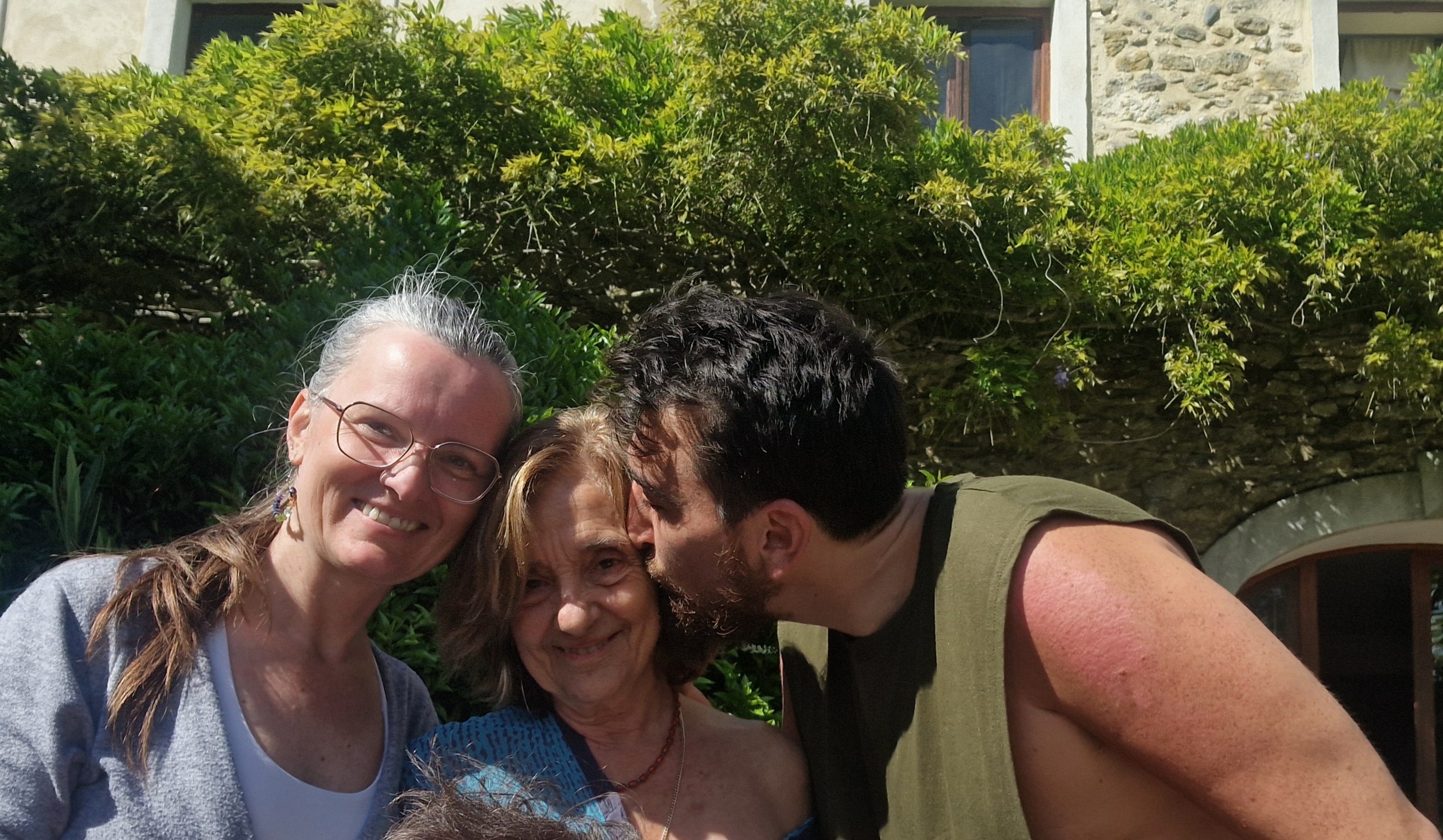
Last week I breathed air that makes you feel different, in company where I felt different. In the middle of the French mountains, without an internet connection, in a place with no public transport, we explored Tandava meditation and searched for sovereignty within ourselves.
I am glad that, as a client, I can surrender to ethical principles that are not aligned with the familiar psychotherapeutic ones, and that I can and may experience the positive sides of that system on my own skin.
I feel I have enough sovereignty to feel completely safe in a system that does not have a prescribed frame in the way I was taught was necessary.
Meeting Komala Lyra and Dez Nichols left me in deep reflection about ethics and working with people.
Watching a walking embodiment of extremely radical sovereignty in action brought me back to my eternal crossroads: questioning the ethics of the system and the ethics of the soul.
Many times in my life I have found myself in a place where I feel resistance toward structures, even though at the same time I can understand their value.
I remember the moment when I could rationally justify the “hospital system” in which we, mothers of children placed in neonatology, went like “little cows” every three hours to breastfeed our children.
My soul was falling apart from pain as I watched my child sleep and be unable to draw milk because of sleepiness, because I was not listening to his rhythm, but to the rhythm of the hospital, a system for which it was easier to “process” us all at once.
It was not fair to that small being. He survived, and later we healed the trauma that arose because the system's most important goal was to save life, not to care for the wellbeing of the being as a whole.
My pain came precisely from the desire for the wellbeing of my child as a whole.
Systems are there to prevent catastrophe, but too often they are the very ones that, in that same place, prevent miracles.
That is why, as a civilization, we have so much illness, because systems have become more important than people.
I remember situations in my work (which my supervisors would probably condemn) when I reached out to a client outside the office and mixed roles.
I believed I was doing her good by giving her support to follow her passion, offering her the job she dreamed of.
I gave her trust that was not easy for me to give. I decided to be a Human instead of a Therapist.
The profession would say: “That is mixing roles, that is not done.” The ethics of my soul said: “That is the only way for her to feel her strength.”
Today I know that, in those moments, I was “unethical” by the standards of books because I chose to give trust where I was not supposed to.
Although it later cost me, in that moment it was the only act of love that made sense to me. And today, with distance, I feel I would once again remain faithful to her soul and to my own.
The price of walking that edge is high.
Sometimes those to whom you have given the most, in their process of growing up, try to cut you down with the very rules you moved beyond in order to help them.
That is the price I had to carry so that she could be her own today.
And I did carry it. After years I received the label that I was not an ethical therapist because, in the moment of separation, she grabbed onto fragments of the relationship rather than the relationship as a whole.
That is exactly what children do to parents in puberty. They separate through anger and by emphasizing the bad parts of parenting, while forgetting the good ones.
Parents need to survive and endure that, because only after that phase comes the integrative one, reconciliation and acceptance of the parent as a whole.
I see that most people who work with others on that edge of ethical principles experience this wound in one way or another.
As a therapist with a Master's in Gestalt, I was raised in a world of rules. I believe they are there as a safety belt that prevents our unconscious shadows from hurting the client.
But Komala says that, in the long term, protective rules that are set in place actually prevent a person from ever truly growing up and taking responsibility for their own boundaries.
I can agree with her, because I see clients who stagnate for years precisely for that reason.
I see the solution in the “middle path”: while the relationship is young and the person is fragile, rules have a function. As the person matures, they need less “stroking”. Psychotherapy is gentle and excellent for fragile structures, while tantra is for those who long to go one step deeper and further.
Gestalt taught me the importance of contact. I had a teacher who could stop and say: “Here I went in the wrong direction and did not see you. Let us start again.”
I valued that part of her personality, because she had a capacity not all therapists have.
The downside of psychotherapeutic schools is that they fenced me in with high walls of what is “allowed” and what is “professional” and what is not allowed, so personally I feel that this energetically places me above the client.
Whatever we do, whether we set rules or not,
the dynamic of power can actually always appear.
The question is: will we look it directly in the eyes when it appears, or will we be “politically correct in gloves” and hide it?
It was inspiring for me to see how Komala uses the domination of power as a mirror.
When I search for the “middle path”, I see myself saying to my client: “Now I am placing myself above you” or “I feel that I am taking over your responsibility”, and in this way I connect Komala's and Dez's philosophy with the therapeutic container.
I can also encourage the client to ask themselves: “Why do you now have the need to hand power over to me? What prevents you from recognizing it in yourself and carrying it?”
I call this “demystifying authority”.
Instead of pretending to be “the one who knows”, I show the process and encourage the client to reflect on themselves and on their sovereignty.
It is a form of ethics in which I do not hide power, but place it on the table as a shared object of observation and growth in awareness.
Gestalt supported me in many areas and I am grateful for that, but I feel insufficiently supported in what I do today.
The core of our vitality is in living eros manifesting through the body.
If we try to mentalize it, it dies. Given the theological roots of Gestalt, it is clear why contact with the raw body is so frightening there and why sexuality is mentalized.
I believe eros is the fastest engine for healing if it is given space.
The positive sides of psychotherapeutic rules give me safety so I do not slip into an ego trip.
The positive sides of Komala's and Dez's approach give me the courage to treat the client as a powerful being, not as a victim of the past and transference.
My work today is that walk along the edge.
I do not offer a sterile office and endless stories about wounds. I offer an encounter with the body and eros as they are.
For those who are ready for work that is sometimes soft and sensual, and sometimes brutally honest.
For those who are not looking for a savior, but for a witness and companion, I am here. Reach out to book a session.